
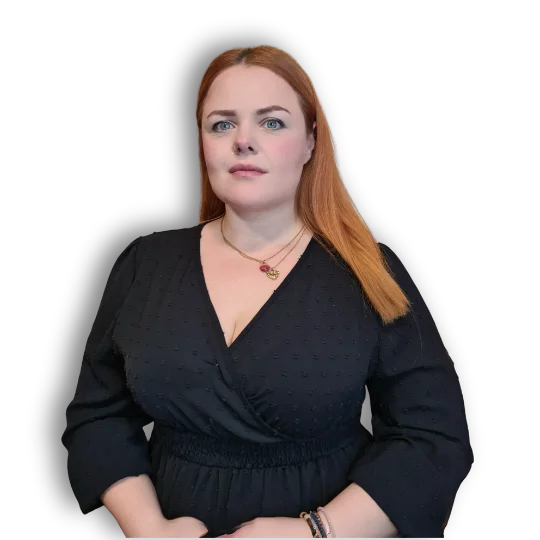
Dr. Sotiria Moza
Cognitive Psychology and Clinical Neuropsychology MSc, PhD, EUROPSY
Dr. Sotiria Moza is a cognitive psychologist and clinical neuropsychologist who completed
her studies in the Lab of Neuropsychology and Behavioral Neuroscience at the School of
Psychology, Aristotle University of Thessaloniki (Greece).
She serves as the Scientific Coordinator at NOESIS Cognitive Center & Tech Solutions and as Head of the Applied Research & Development Department at Materia Group in Nicosia, Cyprus having completed multiple research projects focused on active ageing and wellbeing.
She has extensive experience in Neuropsychological Assessment and Rehabilitation therapy for children, adolescents and older adults since 2013. Her research interests include the understanding and prevention of cognitive decline in old age, multifaceted brain stimulation, the phenomenon of superageing, and cognitive reserve.
She is a regular member of the Hellenic Neuropsychological Society and member of the Hellenic Awareness and Information Committee for Neuropsychology. She has served as guest editor and reviewer in Journals including Frontiers, IHAW and AAIC, an expert reviewer for European Commission and a mentor for the International Youth Neuroscience Association (IYNA) marathon.
She is the Membership Chair of the Alzheimer’s Association International Professional Interest Area: Alliance of Women Alzheimer’s Researchers (AWARE) and served as a co-organiser of the Alzheimer’s Association International Conference Neuroscience Next 2025, in Thessaloniki, Greece.
Indicative publications:
Fantie, B. D., Kosmidis, M. H., Giannakou, M., Moza, S., Karavatos, A., &Bozikas, V. P. (2018). What Is Going On? The Process of Generating Questions about Emotion and Social Cognition in Bipolar Disorder and Schizophrenia with Cartoon Situations and Faces. Brain Sciences, 8(4), 68. |
FrailSafe System: An innovative approach on frailty, S. Moza, M. Polycarpou, S. Nicolaou, HealthManagement.org, 19(5) |
Dardiotis, E., Siokas, V., Moza, S., Kosmidis, M. H., Vogiatzi, C., Aloizou, A. M., … &Hadjigeorgiou, G. M. (2019). Pesticide exposure and cognitive function: Results from the Hellenic Longitudinal Investigation of Aging and Diet (HELIAD). Environmental research, 177, 108632. |
Moza, S., Hadjigeorgiou, G. M., Scarmeas, N., Dardiotis, E., Yannakoulia, M., & Kosmidis, M. H. (2021). Pesticide Use and its Eff ects on Daily Functioning among Elderly Farmers. Journal ISSN, 2766, 2276. |
Moza, S., Polycarpou, M., Hadjicosta, A., Sampanai, R., &Tziannarou, A. (2021). ReMember‐Me system: Developing a new, remote digital tool for detecting and preventing cognitive decline. Alzheimer’s & Dementia, 17, e058021. |
Mettouris, C., Yeratziotis, A., Theodorou, C., Vanezi, E., Achilleos, A., Papadopoulos, G. A., … & Lazic, S. (2021). GUIDed: assisted-living smart platform and social communication for older adults. In Innovations for Community Services: 21st International Conference, I4CS 2021, Bamberg, Germany, May 26–28, 2021, Proceedings 21 (pp. 135-151). Springer International Publishing. |
Seinsche, J., de Bruin, E. D., Saibene, E., Rizzo, F., Carpinella, I., Ferrarin, M., … & Giannouli, E. (2023). A Newly Developed Exergame-Based Telerehabilitation System for Older Adults: Usability and Technology Acceptance Study. JMIR Human Factors, 10(1), e48845. |
Seinsche, J., de Bruin, E. D., Carpinella, I., Ferrarin, M., Moza, S., Rizzo, F., … & Giannouli, E. (2023). Older adults’ needs and requirements for a comprehensive exergame-based telerehabilitation system: A focus group study. Frontiers in Public Health, 10, 1076149. |
Santini, S., Finco, M., Fabbietti, P., Moza, S., Kyprianou, E., Yerou, C., … & Galassi, F. (2023). Quality of Life and Social Inclusion of Migrants and Refugees Attending an Elderly Care Training in Four Mediterranean Countries: Results from the HERO Project. Health & Social Care in the Community, 2023. |
Seinsche, J., de Bruin, E. D., Saibene, E., Rizzo, F., Carpinella, I., Ferrarin, M., … & Giannouli, E. (2023). Feasibility and Effectiveness of a Personalized Home-Based Motor-Cognitive Training Program in Community-Dwelling Older Adults: Protocol for a Pragmatic Pilot Randomized Controlled Trial. JMIR Research Protocols, 12(1), e49377. |
Achilleos, A., Mettouris, C., Yeratziotis, A., Starosta-Sztuczka, J., Moza, S., Hadjicosta, A., … & Papadopoulos, G. A. (2023). Lessons Learned from Older Adults Fusing of an Augmented Reality, Assisted Living and Social Interaction Platform. SN Computer Science, 4(4), 378. |
Moza, S., Sampanai, R., &Tziannarou, A. (2023). The ReMember‐Me Cognitive Assessment Scale‐ReMCAS: Psychometric properties of a new digital tool to remotely assess cognitive function. Alzheimer’s & Dementia, 19, e076475. |

